Introduction
It was fascinating to look at all the different art styles that were prevalent over time, but these were four that I found most interesting. I was drawn to them by their unique aesthetics, or bold designs. Once I began reading, however, I only became more interested. Each one was created out of a different intent, but they all have one thing in common: they are a sort rejections of tradition, or of the systems in place.
Art Nouveau


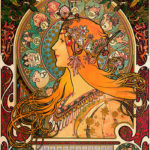
Art Nouveau took inspiration from art movements that came just before it, as well as Japanese woodblock patterns after Japan and the West began trading. The style moved away from rigid designs and moved towards using shapes that feel more organic and natural. Because printing technology was at a point where works could be reprinted and lose little quality, Art Nouveau works could be used commercially, and artists’ personal touches could easily find their way into the public eye. I mention this bit of information because it must have been such an exciting time for artists in so many ways. For one, I really like this art style because it feels like the combining of many ideas, like the liberties it took from traditional art, as well as the amount of personality that could be expressed in these works because of its moving away from depictions of rigid poses or architecture. Additionally, it seems like at this point in time more than ever could an artist express themselves in commercial work, artwork that until then had to have been straight-forward and rather inoffensive. Victor Horta is credited with first creating this movement with his Tassel House project, the centerpiece of which was the staircase shown above. Henri de Toulouse-Lautrec was another notable Art Nouveau artist.
Futurism


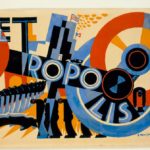
Futurism was a design style of the 1910s that took inspiration from science rather than traditional art forms. As a result, its unique visual style is easily associated to science fiction stories. It incorporates bold motion lines and striking shapes, and tends to break away from purely horizontal or vertical forms. This part of graphic design history instantly caught my eye. The amount of energy exerted from these pieces feels as if the artists are screaming out for some sort of desire for change or progress, given how much this movement breaks away from the art that came before it. Two most notable futurist artists are Edward McKnight Kauffer and A.M. Cassandre.
Suprematism
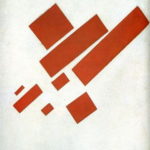
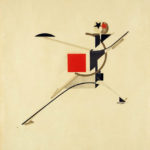
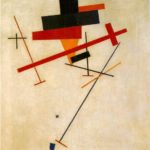
Suprematism found its start in Russia in the 1910s, and it is a style of art that consists of mainly simplistic geometric shapes with few colors. There are no objects, no humans, no symbols. By breaking down art into its most basic elements, as the textbook suggests, the art form sought to “start over in the visual arts, just as the Bolshevik Revolution of 1917 sought to start over leveling society into a classless, stateless, social organization.” Credited with the birth of this movement was Kazimir Malevich with his piece “Suprematist Painting” (left painting). Another Suprematist artist was El Lissitzky.
Dada


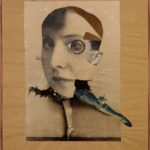
Dada, beginning in the 1910s and continuing into the 1920s, was a complete rejection of World War I. The war used a level of technology that the world had never seen before, and as a result, the Dada movement was conceived. This movement was full of irrationalities, nonsensical elements, irony, and anarchism. The point was that although the art didn’t make sense, it at least made more sense than the thinking that led to something as horrific as the war. I have so much appreciation for this style for how it battles the horrors of war with something so strange yet so bold. I always am a fan of art movements that go against the systems in place, as they tend to always be of pure nature and authentic. Artists like Marcel Duchamp and Hannah Höch have used Dada as a way to revolt against these corrupt systems.
Summary
As I stated at first, all of these styles intend to break away from what was considered the norm. Movements like Art Nouveau and Futurism break away from former traditions of having art be rigid and have focus on horizonal/vertical elements. Movements like Suprematist and Dada go even further and are built on anti-establishment ideals, combating the powers that are in place while being in favor of a more just society. It’s incredible to see the different ways in which these sentiments can be expressed, and how even a hundred years ago, there were artists that would strive to combat tradition and corruption.
