Design Principles in the Real World
1. Repetition
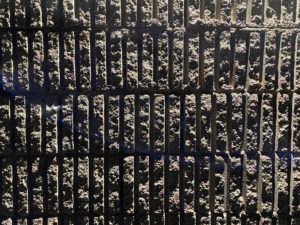
The first item that caught my attention was a cement building with repeating groves on every side. Whenever I walk by this tiny structure I wonder what the reasoning is, whether practical or aesthetic, all I can conclude is that it repeats a LOT.
2. Rhythm

This thank you sign creates a sort of rhythm in the way that it is directing a drivers attention for where to leave. The three arrows with equal spacing is what’s clearly indicating the exit.
3. Proportion

This one made me laugh when I stumbled upon it, the picture doesn’t quite do a justice but the dumpster on the right is obviously much larger than the one to the left. The dumpster way in the back also helps get an idea of the proportions, the one in the middle being almost half the size.
4. Hierarchy

This image gives a sense of hierarchy by the way the stairs slowly descend to the pavement, they allow you to get a higher elevation. As well as the way the stairs stack against one another it could almost resemble a bar graph if you stretch your mind a bit.
5. Variety

This photo clearly shows variety in the vehicles that everyone drives, even though they all perform somewhat similar tasks, there’s still a wide range of cars used among people. Whether it be size, color, or function.
6. Unity

Lastly, these three cameras stacked on top of each other is what gave me the idea for unity, they are all branching off of the same post. When I look at this I think of them as a unit or 1, even though it’s composed of three parts.
Gestalt Theory
Prior to researching the Gestalt Theory through these links, I had already known about its existence, and origin. I also had somewhat of an idea that designers incorporate it to trick your mind, or make you feel a type of emotion subconsciously. After reading through the articles I started to see how broadly it’s used, and in how many different ways. For example I had no idea before that there were so many different forms of this theory used in design, like parallelism, or continuity. I think almost all types of ways designers use these techniques is very subtle, but it gives character and an added sense of depth to the artwork.
