Graphic Design History
The development of graphic design throughout history can tell us a lot about the timeline of culture and technology. Graphic design began in many different forms, one being as a way to translate stories and traditions through visual art, and morphed into what we know it as today. Graphic design is believed to have begun with Chinese woodblock printing. Art and designs such as woodblock carving, later developed during the industrial expansion to bring us the beginning of modern graphic design such as the ones that came with the Arts and Crafts Movement, Art Nouveau, Cubism, and Futurism. These four periods in design history laid the structure for what was to come, and acted as the catalyst of modern design.
The Arts & Crafts Movement (1880-1910)
The arts and crafts movement took place during a time of social and political turmoil, and in the eyes of some historians is seen as an act of social rebellion. The arts and crafts movement relied heavily on handmade creations and the physical and spiritual pleasure that connected individuals to their work. During this time natural forms of art were valued in contrast to the age of Industrial Expansion. Examples of some forms of art that came out of this time period that included and contributed to the history of graphic design are ceramics, cabinetry, textiles, and stained glass. These were the mediums used to express meaning through graphics during the arts and crafts movement. The photos below represent some forms of art that were popular during this particular movement. I enjoyed researching about this period in graphic design history not only because crafts are my favorite, but because this form of design is still popular today, and even making a comeback as many people are stuck at home during the Pandemic, many people are turning to handmade crafts.
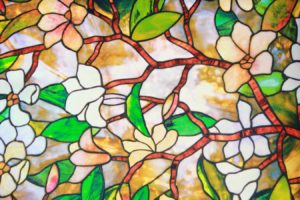
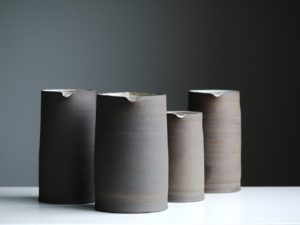

Svitlana, “Linen Napkins”, Unsplash
Art Nouveau (1890-1910)
Inspired directly from The Arts and Crafts Movement, Art Nouveau would become known as the turn of the century art movement. Happening at the same time as The Arts and Crafts movement, this form of design would become known as the first step towards modern design, as it had a clearly defined theme, using flowers, vines, and birds to create scenes of lush greenery, in attempt to soften the effects of The Industrial Expansion. The beautiful natural designs popular during the Art Nouveau time period translated into paintings, ceramics, and many other forms of visual art. This form of design was also present and was translated into the architecture and interior design of this time period, and can be seen in many historic homes. I loved researching this period of time in design history because it’s very feminine, and unique; which is a big reason why this design style of using natural scenery is still commonly used today. The photos below are flower prints designed in the Art Nouveau style, the one titled “Ancolie” uses the famous Art Nouveau color “peacock blue”. The yellows and oranges used in “Nasturtium” are similar to the colors commonly used by Vincent Van Gogh, who was said to paint in a similar style to Art Nouveau, this is particularly present in “Sunflowers”.
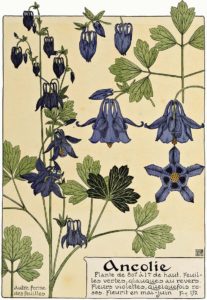
Ancolie, “La Plante et ses applications ornementales sous la direction de M. Eugène Grasset” 1896, Maurice Verneuil.
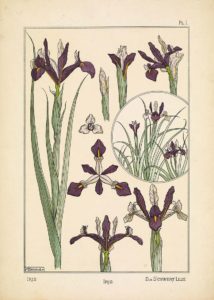
Iris, “La Plante et ses applications ornementales sous la direction de M. Eugène Grasset” 1896, Maurice Verneuil.
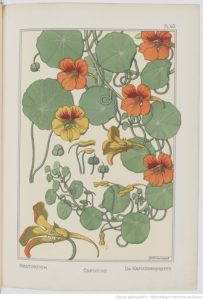
Nasturtium, “La Plante et ses applications ornementales sous la direction de M.Eugène Grasset” 1896, Maurice Verneuil.
Cubism (1907-1921)
Cubism was derived from different forms of African art, and was given unique abstract qualities such as contrasting color, shape, and size to create a bold appearance. Cubism became known as the famous style of Pablo Picasso, who created and inspired others with his bold theories of spacial patterning and timing within his designs. Cubism became an easily identified style of art, and during this time period artists like Erik Satie began incorporating concepts of cubism within other forms of art such as composition and music, which brought a new life to cubism. The sharp edges create bold contrasts within the design and is meant to draw attention, something Pablo Picasso would become known for. Cubism was another interesting contrast to the prior design techniques before it, specifically Art Nouveau which focused on natural scenery that flowed and blend beautifully. This type of art is meant to stand out and catch eyes which is why I enjoy cubism as a style of design.
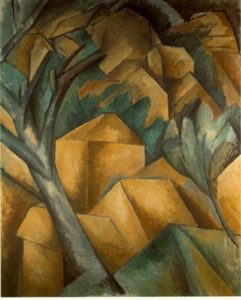
Houses at Estaque, 1908, Georges Braque
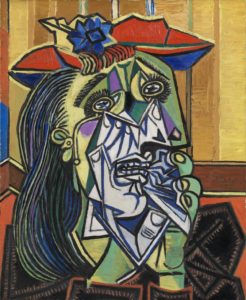
The Woman Weeping, 1937, Pablo Picasso
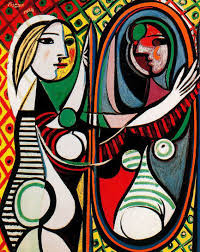
Girl Before A Mirror, 1932, Pablo Picasso
Futurism (1910-1918)
Artists and graphic designers both had a new found sense of freedom and expression with Futurism. Prompted heavily by cubism, futurism was a social movement that impacted artistic style and allowed the arts to flourish during this time period. Futurism like cubism, used abstract shape, colors, and sizes to manipulate space and create a piece that turned heads. For the time period this form of art was extremely expressive and allowed artists to step outside the boundaries in a way they never had before, now futurism is a common technique used in many advertisements, specifically for technology products such as Apple. Futurism is an interesting design technique to research, because for obvious reasons it appearance is very modern, for example this picture painted by Giacomo Balla looks like it could be a modern day sculpture, yet it was only painted in 1915. Modern day futurism, while more subtle, can give us the same feeling of amazement, as if we’re looking into the future.
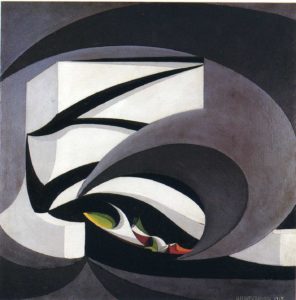
Flags at the altar of the Motherland, 1915, Giacomo Balla
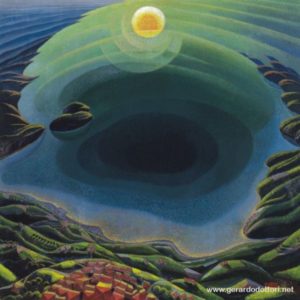
Aurora sul Golfo, 1935, Gerardo Dottori
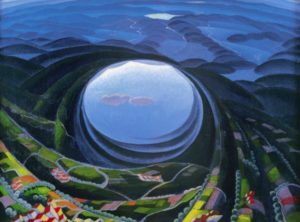
Primavera Umbria, 1923, Gerardo Dottori
One aspect of art and design that remains constant is the ability to push boundaries. Art and design act as reflections of each time period, and can encapsulate a moment in history by controlling design technique. My favorite part of design is that popular styles are always changing, and can have ripping effects on art, fashion, music, architecture, and advertising. When looking at Art Nouveau and cubism, there are many contrasts between the two styles, yet the two time periods happened back to back. Many people may say these two styles have nothing in common, but in fact, it is the previously existing art style that inspires the one to come. In this case we see extreme opposites, going from the beautiful natural delicate styles of Art Nouveau to the harsh sharp contrast of Cubism.
