Graphic Design History:
As a brief history of graphic design, Chinese paper was a substitute for printing on cloth, but was later used as a parchment skin in the eighth century and was one of the society’s innovations that reflected cultural and economic needs. However, if we want to become graphic designers someday, our designs will impact not only the culture and economy, but it will also impact on the social and political worlds. I agree that the designs we make will reflect other perceptions of our world. The styles that stick out to me in this reading are the Arts and Crafts Movement (1880-1910), Aestheticism (1870-1914), Constructivism (1919-1934), and 1960s Psychedelic Language. I didn’t know a lot of the different forms of graphic designs were all introduced in England, this includes: Paper, advertising, photography, typesetting, typefaces, and book typesetting. Graphic design is pop culture and its influence includes: music, art, film, video,..etc is what draws people in to look at and admire.
Arts and Crafts Movement (1880-1910):
I am fascinated in William Morris(1834-1896)’s work and how he recreated the past, especially the page design The Canterbury Tales made in 1896. The Canterbury Tales I notice has three fifteenth-century type styles in the typefaces he used that are all beautifully prescribed. I enjoy looking around the floral background and how I can capture a scenery and text written in the center of the page design. My eyes follow all around Morris’s Kelmscott Press as the floral and swirled stems are handcrafted and it completes the work. The one thing that satisfies me about his handcrafted forms of art is that it brings physical and spiritual pleasure and I can see that especially in his The Canterbury Tales and as well as his Guinevere and Iseult: Cartoon for Stained Glass 1862.


Aestheticism (1870-1914):
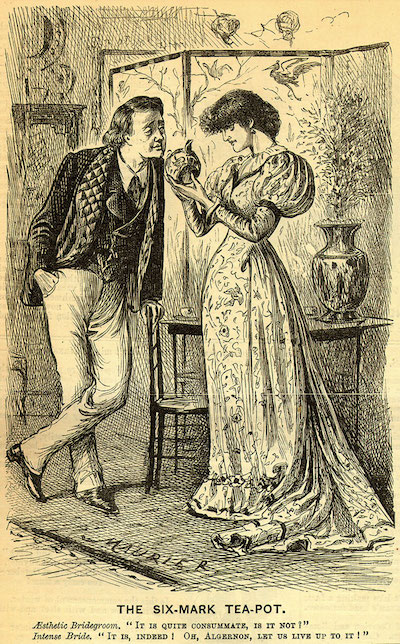
I am interested in the aesthetic movement because it became a form of art that separated morality and utility and brought together art and life. It’s theme is “art for art’s sake” phrased by Victor Cousin(1792-1867) which drew my attention into the reading. Beginning as early as 1818, this specific movement took art and its purpose in this world to a further approach than the arts and crafts movement did later on. It is different from William Morris’s famous page designs, but I feel like it can form a new outlook and can express ideal beauty for people if they want to see an improved version of the Arts and Crafts style.

Constructivism (1919-1934):
Vladimir Tatlin‘s(1885-1953) abstract art (influenced by Pablo Picasso’s cubist constructions) of Monument to the Third International caught my attention as the construction of glass and steal spirals like a spiral staircase. In my Foundations of Design’s course I took, I remember incorporating architecture which was twisted steps in a White Cube design made of foam. With my White Cube design, I drew viewers into the space and one can imagine themselves shrinking down in size and moving around the room inside the cube and up the stairs. This is how I can feel with Tatlin’s design. Tatlin disagrees in the phrase “art for arts sake“, but I believe in both of Victor Cousin’s(1792-1867) and Vladimir Tatlin’s views, that artwork should have a political purpose (Cousin) and a social purpose (Tatlin).

1960s Psychedelic Language:
While looking at one of the few formally trained designer Victor Moscoso’s(b. 1936) psychedelic posters, especially his Concert Poster for the Chambers Brothers made in 1967 the artwork pops out at me as I read the text. The emphasis of the blue on a pink and orange-yellow background makes the poster stand out to me from the other images in each movement. Milton Glaser’s(b. 1929) poster illustrated for the singer-song writer Bob Dylan is colorful to me, as a black silhouette is shown with saturated colors for curly strands of hair standing out from a white ground. I heard about Bob Dylan specifically from watching American Idol with my family every year and hearing the singers on the show preform one of his songs or one of the singers sounding like Bob Dylan. Bob Dylan has a unique and intriguing voice that fans can fall in love with, and I enjoyed learning that Glaser made a poster for him.


Summary:
Paper, invented in China reflected cultural and economical needs as one of the society’s innovations. If we think about graphic design as a whole, it can be able to impact viewers anywhere; socially, culturally, politically, and economically. Pop culture is graphic design. The Arts and Crafts Movement (1880-1910), Aestheticism (1870-1914), Constructivism (1919-1934), and 1960s Psychedelic Language are forms of art from the text that stood out to me. If we become graphic designers someday and create designs that are influenced in listening to music or directing a film, people who fit into those genres are going to love our style. The designs we make as artists will reflect other people’s perceptions all around the world.
